Taking Custom Design to New Levels
PROUD TO BE PART OF THE BRIN FAMILY OF COMPANIES

OTHER BRIN LOCATIONS
Brin Glass Company | Minneapolis, MN
St. Germain’s Glass | Duluth, MN
Heartland Glass | Waite Park, MN

Choosing the right mobile robots begins with the work your business needs done, not with a product brochure. A warehouse moving small cartons has different demands from a factory transporting heavy fixtures. Map the route, payload, floor conditions, shift length, and handoff points. Watch where workers pause, turn, or wait. These details often reveal whether automation will solve a real bottleneck or simply move it elsewhere.
Compare navigation methods, safety features, charging needs, and integration requirements against those observations. Ask vendors for task-specific demonstrations, clear performance assumptions, and support plans. A robot’s advertised capacity matters less if aisles are crowded or loads vary throughout the day. Check how the system handles blocked paths and changing workflows. Small operational details count.
Pilot before committing at scale. Track completed trips, downtime, interventions, and the time employees spend managing the system. Include the people who will work alongside the robots; they may notice awkward handoffs that a spreadsheet misses. No estimate is perfect. Early results can expose gaps in your assumptions, and that is useful. The right mobile robots should fit existing processes where practical, improve measurable outcomes, and leave room for future changes. This guide explains how to assess those factors and make a grounded choice for your business.
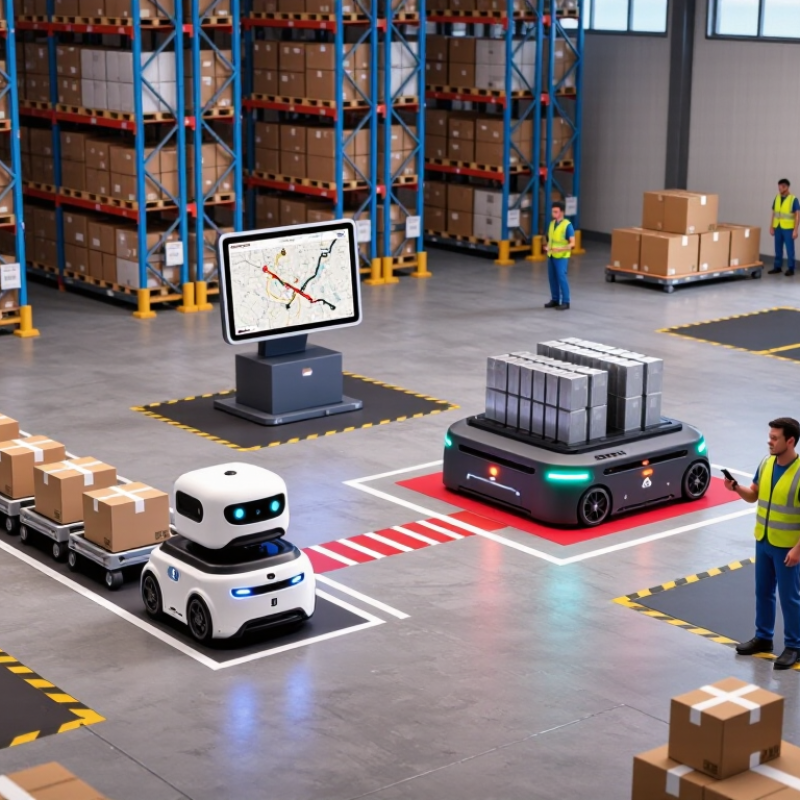
IFR logged 86,000 logistics robots sold in 2022, a striking measure of demand for automated material movement. But a market figure cannot tell you which robot fits your operation. Start by mapping what actually moves: cartons, pallets, totes, or mixed loads. Note each load’s weight, dimensions, pickup point, and destination.
Watch the workflow during a busy shift. How many trips happen per hour? Where do queues form? A robot suited to steady pallet transfers may struggle with narrow aisles, changing drop-off points, or frequent manual handoffs. Measure travel distances and wait times, too. Small delays add up.
Then match capacity to the real need. Check floor conditions, aisle widths, lift heights, and how workers share routes with machines. Confirm that the robot can connect with doors, lifts, and warehouse software. Test a representative route before committing.
That number matters. Yet planning can still miss the odd oversized package or a temporary stack of goods. Leave room for those imperfect days, and review performance after deployment rather than assuming the original flow map stays accurate.
The best choice depends on how predictable your routes are. Automated guided vehicles (AGVs) typically follow defined paths, such as floor markings, wires, or reflectors. They can suit repeatable trips between fixed points, like moving pallets from a staging area to a production line. Changes to the route may require adjustments to the guidance system. That matters.
Autonomous mobile robots (AMRs) use sensors and onboard navigation to move through mapped spaces and respond to obstacles. They may fit facilities where people, carts, or workstations shift during the day. Still, an AMR needs clear operating rules, suitable space, and careful testing. It cannot make a crowded aisle risk-free. A route that seems flexible on screen may become slow when workers leave carts near a doorway.
Tips: Track a typical shift before choosing. Note blocked aisles, delivery frequency, and how often destinations change. Test a short route during normal operations, not only after hours. Compare travel time, stopping behavior, and how easily staff can manage exceptions. The first route plan often looks cleaner than reality; revise it when observations disagree.
ISO 3691-4:2020 sets safety requirements for driverless industrial trucks and their systems. Treat it as a safety framework, not a shopping checklist. Start with the heaviest load the robot will actually carry, including the container, attachments, and any off-centre items. A stated payload may not reflect a tall, unstable tote or a load that shifts during a turn. Check stopping behavior, protective functions, and operating zones against the standard’s requirements. Small details matter.
Map the real route, not just the clean version on a floor plan. Measure the narrowest aisle, doorways, turning points, floor transitions, and space beside racks. Include load overhang and clearance for pedestrians. The International Federation of Robotics’ World Robotics 2024 report recorded 113,000 professional transport and logistics service robots sold in 2023, a 35% increase from 2022. That growth makes careful site assessment more important, not less. A neat CAD drawing can still hide a bad turning point.
Test the proposed route with the actual vehicle and load where possible. Check one-way and two-way traffic, crossing points, docking space, and the distance needed to stop safely. Compare these conditions with your risk assessment and ISO 3691-4:2020 requirements. A spreadsheet can look precise. One overlooked corner can undo the plan.
Assess Fleet Software, System Integration, and Mixed-Traffic Safety
The International Federation of Robotics’ World Robotics 2024 report recorded about 113,000 professional service robots sold for transport and logistics in 2023, up 35% from 2022. Fleet software is therefore a practical buying criterion, not an optional extra. Check how it handles charging queues, blocked aisles, urgent tasks, and Wi-Fi interruptions. Ask for a live demonstration on your own floor. A polished dashboard proves little.
Integration deserves the same scrutiny. MHI’s 2024 Annual Industry Report found that 55% of respondents were increasing supply-chain technology investment. Test connections with warehouse systems, doors, lifts, and safety controls, including what happens when an interface fails. Set clear ownership for alarms, timestamps, and software updates before a pilot begins. Small gaps become expensive.
For mixed traffic, assess pedestrian routes and robot behavior together. ISO 3691-4:2023 covers safety requirements and verification for driverless industrial trucks and their systems. Test stopping distances with a full load, at crossings, and on the actual floor surface. Watch what happens when a person steps into a robot’s path. Track manual interventions and near misses per shift. The test area may be tidy; daily operations rarely are.
A mobile robot’s quoted price is only one part of its lifecycle cost. Before a pilot, map the work it will actually perform, such as moving totes between a packing station and a shipping area. Include integration, charging equipment, floor changes, software, operator training, maintenance, and downtime in the estimate. Small costs add up. Ask technicians and floor staff where delays or workflow changes are likely; their observations can reveal expenses a proposal may miss.
Build a cost-per-task comparison using current operating data. Record labor hours, completed moves, waiting time, and handling errors before the pilot. Then measure the same figures during representative shifts, including busy periods and routine interruptions. Not just demos. Track how often robots need assistance, pause for charging, or encounter blocked routes. A short pilot may not capture seasonal variation, so treat early results as estimates, not promises.
Estimate ROI using benefits the site can verify, such as reduced travel time or more consistent task completion. Count labor savings only when staff time can be reassigned or a real operating cost is avoided. Model optimistic, expected, and conservative outcomes, including maintenance and replacement costs over several years. If payback depends on perfect uptime, revisit the assumptions. Scaling can change traffic patterns, charging demand, and support needs, so leave room for those uncertainties in the budget.
Taking Custom Design to New Levels

Brin Glass Company | Minneapolis, MN
St. Germain’s Glass | Duluth, MN
Heartland Glass | Waite Park, MN

Fabricator
Inside Sales and Client Support Manager
Glass Handler – 1st Shift