What Are the Top Types of AI Robots for Businesses?
Businesses are no longer asking whether robots belong in the workplace. They are asking which systems can handle real tasks safely, reliably, and at a sensible cost. The answer depends on the setting: a factory floor, a warehouse aisle, a hospital corridor, or a customer-facing service desk. Each environment calls for different capabilities.
The International Federation of Robotics’ World Robotics 2024 report recorded 541,302 industrial robots installed worldwide in 2023. Its service-robot report counted about 205,000 professional service robots sold that year, a 30% increase over 2022. These figures point to a broad mix: industrial arms and collaborative robots, autonomous mobile robots, inspection systems, and professional service robots. They do not prove that every business needs one. A robot that moves pallets efficiently may be poorly suited to delicate assembly.
AI researcher Andrew Ng has described AI as “the new electricity.” For businesses, that idea becomes concrete when software helps a machine perceive, plan, or adapt to changing conditions. But “AI-powered” is not a performance guarantee. Buyers still need to test a system against actual workflows, maintenance needs, and safety requirements.
This guide examines the top types of AI robots for businesses and what each can—and cannot—do. The categories overlap, and vendor labels can blur useful distinctions. That is worth keeping in mind. A careful pilot, measured against clear operational goals, often reveals more than a polished demonstration.
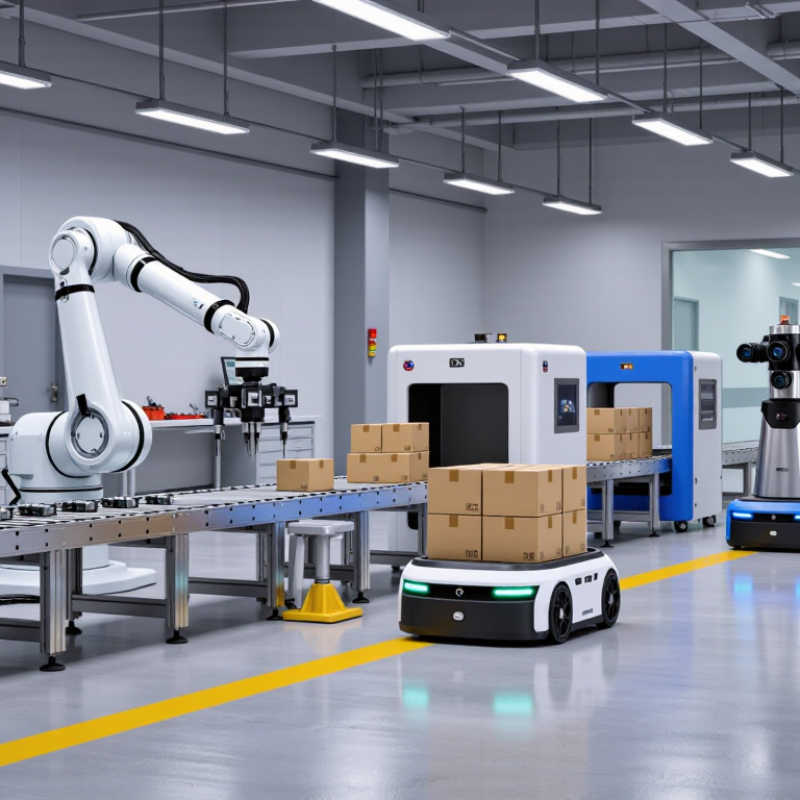
How Are AI Robots Defined and Classified in Business?
In business, an AI robot is a physical machine that senses its surroundings, processes information, and acts on a task. Sensors gather signals such as images, distance, or temperature; actuators move wheels, arms, or grippers. AI may help the machine recognize objects, predict movement, or adjust its actions. Not every robot uses AI, and not every AI system has a body. That distinction matters.
Businesses can classify robots by job, mobility, and level of human oversight. Industrial robots work in fixed areas, often handling welding, assembly, or palletizing. Mobile robots move materials through warehouses, while service robots perform tasks such as cleaning or inspection. Collaborative robots are designed to work near people, though the specific safeguards depend on the application. The categories blur in practice. A mobile platform with a camera might carry goods, inspect shelves, or both. The International Federation of Robotics reported 4,281,585 industrial robots operating worldwide in 2023. Its World Robotics 2024 report also recorded nearly 205,000 professional service robot sales that year. These figures show adoption, not proof that every deployment delivers value. A classification should therefore describe what the robot does, where it operates, and how decisions are supervised—not simply label it “AI.”
Which Technologies Enable AI Robots to Perform Business Tasks?
AI robots combine sensors, software, and mechanical control to handle business tasks. Cameras and depth sensors help them identify people, packages, shelves, and obstacles. Computer vision turns those images into usable information. Language-processing systems can interpret spoken requests, such as “bring this parcel to the packing station.”
In a warehouse, the robot may scan a shelf label, choose a clear route, and stop when a worker crosses its path.
That matters. These systems still depend on good lighting, clear instructions, and reliable sensor readings.
Machine-learning models help robots recognize patterns and improve decisions from operational data. Planning software breaks a task into steps, while motion-control systems guide wheels, arms, or grippers with measured movements.
Edge computing can process camera data on the robot, reducing delays; cloud services can support updates and analysis across a fleet. Connections to inventory or scheduling systems let robots receive relevant work details.
Yet integration takes testing. Reflective packaging can confuse vision models, and background noise can distort speech.
Staff should review performance logs, set clear override procedures, and retest after workflows change.
A robot can be capable and still awkward around an unexpected obstacle.
What Are the Main Types of AI Robots Used by Businesses?
Businesses use several kinds of AI robots, chosen for specific tasks rather than general intelligence. Autonomous mobile robots move bins, parts, or finished goods through warehouses and factory floors. Sensors help them avoid people and obstacles, while fleet software can route jobs. They work best on predictable routes with clear pickup points. Crowded aisles still cause delays.
Collaborative robot arms assist with repetitive tasks such as placing components, tightening screws, or packing small items. Cameras and force sensors can help them adjust to changes in position or pressure. Machine-vision robots inspect products for defects, including uneven seams or missing labels. These systems can check many items consistently, but poor lighting or unusual materials may reduce accuracy. Human review remains useful.
Businesses also deploy service robots for tasks such as moving supplies, cleaning floors, or guiding visitors. In some settings, drones inspect roofs, equipment, or large outdoor sites where access is difficult. Newer humanoid robots attract attention, but their practical value varies, and many tasks remain easier to automate with simpler machines. That distinction matters. A small pilot can reveal whether a robot saves time, fits existing workflows, and is easy for staff to supervise. Real-world results can be less tidy than a demonstration.
What Are the Main Types of AI Robots Used by Businesses?
Transportation and logistics robots—including autonomous mobile robots used to move goods—are widely deployed in business operations. Hospitality robots support tasks such as delivery and customer service. The figures show global professional service robot sales in 2022, not AI-only robots.
Source: International Federation of Robotics, World Robotics 2023 — Service Robots.
How Do These Robot Types Support Different Business Operations?
Autonomous mobile robots (AMRs) move cartons between warehouse aisles, loading areas, and packing stations. Their sensors help them adjust to people and shifting obstacles. The International Federation of Robotics (IFR) reported about 113,000 professional service robots sold for transportation and logistics in 2023. That figure reflects demand for moving goods, not a guarantee that every site will save money. Layout changes and charging downtime still matter.
AI-enabled robotic arms handle repeatable tasks such as sorting, machine tending, and visual inspection. Collaborative robots can support workers at shared workstations, though safe deployment depends on task design and training. IFR’s World Robotics 2024 report counted 4.28 million industrial robots operating worldwide in 2023.
Inspection robots add another option: cameras and sensors can check equipment in hard-to-reach areas, reducing routine manual checks. A demo can look smooth. Real shifts are messier. Businesses should test systems against actual cycle times, error rates, and maintenance needs; AI does not remove the need for human oversight.
What Factors Guide the Selection of AI Robots for Businesses?
Choosing an AI robot starts with the work, not the technology. A warehouse may need mobile robots to move totes, while a factory may benefit more from robotic arms for repetitive handling. The International Federation of Robotics reported that professional service robot sales reached nearly 205,000 units in 2023, up 30% from the previous year. Transport and logistics robots accounted for about 113,000 units. That growth shows demand, not guaranteed savings. Fit matters more.
Map the task before comparing machines: payload, travel distance, cycle time, floor conditions, and human traffic. Check whether the robot can connect to existing software and whether staff can manage exceptions. Safety features matter around people, especially near blind corners or busy workstations. Ask about maintenance, spare parts, training, and support response times. A polished demo can still hide a poor fit. Pilot the robot in a real shift, then track downtime, completed tasks, and labor hours against a clear baseline.
Tips: Set one measurable goal, such as reducing tote-transfer time by 15%. Test the robot on your busiest route, not an empty demo floor. Keep the trial small; awkward edge cases often reveal what the sales presentation missed.



Fabricator
Inside Sales and Client Support Manager
Glass Handler – 1st Shift