How to Choose Carbon Steel Mesh for Your Project
Choosing Carbon Steel Mesh is not just a matter of picking a wire size from a catalog. The right option depends on what the mesh must do, where it will be installed, and how it will be supported. A screen facing abrasion may need a different wire diameter and opening size from mesh used for fencing or reinforcement. Small details matter. A few millimeters can affect fit, flow, strength, and installation time. Materials-selection authority Michael F. Ashby’s approach can be paraphrased this way: “Choose materials for their service conditions, not for one appealing property alone.” That is a useful starting point, not a substitute for project specifications.
This guide explains how to compare mesh openings, wire diameter, mesh pattern, steel grade, and surface finish. It also considers load, exposure to moisture, fabrication needs, and the practical limits of handling and installation. For example, a panel stored outdoors may need a different corrosion-protection plan from one used indoors in a dry workshop. Check supplier data, drawings, and applicable project requirements before ordering. Ask for samples when appearance or fit is uncertain. Small trial. Real insight. One detail is easy to overlook: a coating can affect dimensions and may not suit every environment. The choice can feel less tidy than a table suggests. That is worth admitting. The goal is not to find a universally “best” Carbon Steel Mesh, but to select a documented, workable specification that matches the job and can be checked before installation.
Understanding Carbon Steel Mesh and Its Common Forms
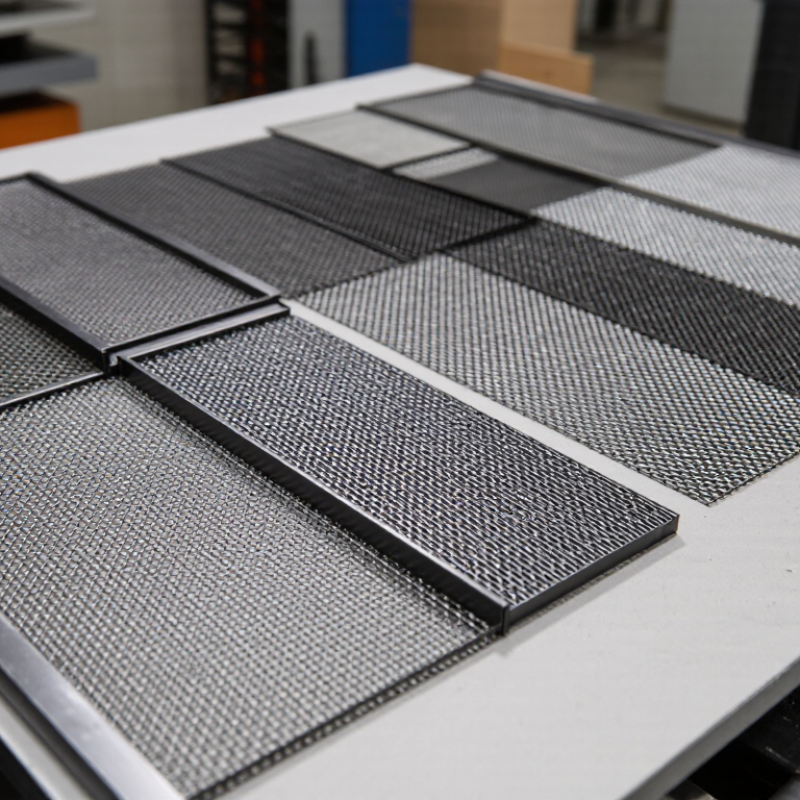
Carbon steel mesh is made from steel wires or sheets arranged into a regular pattern. It is valued for strength, stiffness, and relatively straightforward fabrication. The exact form matters: two meshes with similar openings can behave differently under load. Woven mesh uses wires crossing over and under one another, much like a compact grid. It can suit screening and filtration, where consistent openings help control material flow. Welded mesh joins intersecting wires at fixed points. Check the joints. They help the grid retain its shape, though heavy impact or poor support can still cause distortion.
Expanded metal is cut and stretched from a solid sheet, leaving diamond-shaped openings without separate wire intersections. It is often used for guards, walkways, and ventilation panels. Crimped woven mesh has bends in its wires that help hold them in position, especially with coarser openings. When comparing forms, note wire diameter, aperture size, open area, and the required load. A caliper and a simple opening measurement can catch specification mismatches before ordering. Also consider exposure: untreated carbon steel can rust in damp or outdoor settings, so a suitable coating may be needed. Coatings change dimensions slightly. That detail is easy to overlook, and it may affect fit.
How to Choose Carbon Steel Mesh for Your Project
Understanding Carbon Steel Mesh and Its Common Forms
Opening size affects what a mesh can screen, support, or allow through. Woven wire cloth is available in fine openings, while welded mesh commonly uses larger, regular openings. Expanded metal and perforated sheet offer other patterns and opening shapes. Values shown are illustrative nominal examples in millimeters, not universal specifications; available sizes vary by product. Check the required opening, wire or sheet thickness, load, and finish before choosing.
Defining the Project’s Load, Opening, and Size Requirements
Before choosing carbon steel mesh, define the load, opening, and finished dimensions. Record whether the mesh will carry a steady load, repeated impacts, or only light screening. These conditions change the required wire diameter and support spacing. EN 1993-1-1 uses a steel density of 7,850 kg/m³ for structural calculations; this helps estimate mesh weight, but it does not establish load capacity. Capacity also depends on wire geometry, weld quality, edge restraint, and how the load reaches the supports. A tidy calculation can miss a loose frame connection.
Specify the clear opening, not just the mesh count. ISO 9044:2016 addresses technical requirements and testing for industrial woven wire cloth, including aperture tolerances. That matters when particles must pass through consistently. For example, a 10 mm nominal opening may not suit a process that rejects particles only slightly larger; check the actual tolerance and wire thickness with the supplier. Measure the installation space at several points, too. Frames are not always square.
Tip: Sketch the loaded area, mark support points, and note the largest expected load. Then check the mesh deflection and connection details with a qualified engineer. A sample panel can reveal handling or fit issues, though it cannot replace a design check.
How to Choose Carbon Steel Mesh for Your Project - Defining the Project’s Load, Opening, and Size Requirements
| Project Requirement | Example Starting Specification | Opening and Wire Details | Panel Size to Confirm | Selection Considerations |
| Light-duty partition or protective screen | Welded carbon steel mesh; 3 mm wire diameter; 50 mm center-to-center pitch | Approx. 47 mm clear opening in both directions | Measure the finished frame opening and allow for the specified fixing method | Confirm impact exposure, edge support, and whether the mesh needs a coating for the environment. |
| General-purpose guard or equipment enclosure | Welded carbon steel mesh; 4 mm wire diameter; 50 mm center-to-center pitch | Approx. 46 mm clear opening in both directions | Specify finished width and height, plus any required trimming or fixing allowance | Check the required access restriction and the strength of the complete frame-and-fixing assembly. |
| Screening where a medium opening is required | Welded carbon steel mesh; 5 mm wire diameter; 100 mm center-to-center pitch | Approx. 95 mm clear opening in both directions | State panel dimensions and whether the mesh must fit within or overlap the supporting frame | Verify that the clear opening meets the screening need; larger openings allow larger objects to pass through. |
| Robust barrier with a relatively open pattern | Welded carbon steel mesh; 6 mm wire diameter; 100 mm center-to-center pitch | Approx. 94 mm clear opening in both directions | Confirm unsupported span, support locations, and finished panel dimensions | Wire diameter alone does not establish load capacity. Have the assembly checked for its actual span and loading. |
| Large-opening panel for a defined structural application | Welded carbon steel mesh; 8 mm wire diameter; 150 mm center-to-center pitch | Approx. 142 mm clear opening in both directions | Provide the exact panel size, support layout, edge conditions, and connection details | Obtain an engineering check for applied loads, deflection limits, welds, supports, and connections before use. |
Important: Examples are preliminary selection references, not load ratings. Approximate clear opening is calculated as center-to-center pitch minus wire diameter. Actual capacity depends on mesh construction, material properties, panel span, support and fixing details, load direction, and applicable design requirements. Confirm dimensions and specifications with the supplier and a qualified engineer.
Comparing Wire Diameter, Mesh Pattern, and Strength
Wire diameter and mesh count work together, but they answer different questions. Mesh count is the number of openings per linear inch; thicker wire leaves smaller openings at the same count. Using the ASTM E2016 woven-wire-cloth convention, a 10-mesh screen has a 2.54 mm pitch. With 1.0 mm wire, the theoretical opening is about 1.54 mm before manufacturing tolerances. Check the measured aperture, not just the mesh label. Small details matter.
Pattern affects both flow and durability. Plain weave gives each wire frequent support, making it a practical choice for screening and general separation. Twilled weave can accommodate heavier wire at a given mesh count, though its openings and surface behave differently. ISO 9044:2016 sets terminology and specifications for industrial woven wire cloth; compare its opening and tolerance requirements with the supplier’s test data. A drawing alone is not enough.
Strength depends on steel grade, wire diameter, weave, and how the mesh is fixed at its edges. For an individual wire in tension, cross-sectional area rises with diameter squared: increasing diameter by 20% gives roughly 44% more area, before considering joints or defects. ASTM A510/A510M covers carbon-steel wire rod and coarse round wire, but the grade-specific mechanical values still need checking. This estimate is useful, not a load rating. I would test a sample under the actual support and impact conditions; specifications can miss the awkward failure point.
Choosing a Finish for the Installation Environment
For carbon steel mesh, choose the finish for the wettest, dirtiest conditions it will face—not just the average day. In a dry indoor room, an uncoated mesh may be adequate if occasional surface rust is acceptable. Outdoor exposure, wash-downs, or salty air usually call for a protective coating. The NACE International IMPACT study estimated corrosion’s global cost at US$2.5 trillion, or 3.4% of global GDP, in 2013. That figure covers many industries, not mesh alone, but it shows why corrosion protection deserves attention.
Hot-dip galvanizing can provide a durable zinc layer, while paint or powder coating can add color and a barrier against moisture. Check how the mesh is made: cutting or welding after coating can expose bare steel, and tight intersections may be difficult to coat evenly. For coastal or chemical sites, confirm the coating’s suitability with the supplier and document the expected exposure. I would not assume that “outdoor rated” means suitable for every site.
Tips: Ask whether the mesh is galvanized before or after fabrication. Inspect cut edges, welds, and corners, where protection may be thinner. Keep a small sample outdoors for a few weeks; it is not a formal test, but it can reveal obvious mismatch.
Verifying Product Quality and Supplier Specifications
A reliable carbon steel mesh specification should describe more than the sheet size. Confirm the wire diameter, opening dimensions, mesh pattern, steel grade, and any coating. Ask whether measurements refer to the finished mesh or the wire before weaving. That difference can affect fit. Small details matter.
Request a current inspection report or material certificate, and check that its heat or batch number matches the shipment documents. Ask how the supplier measures openings and wire diameter, and whether the measuring tools are calibrated. For a sample, measure openings in several places with a ruler or caliper. Edges and corners may vary. One measurement is not enough.
Clarify tolerances in writing, including permitted variation in sheet dimensions, flatness, and opening size. Ask how the mesh is packaged to prevent bent wires or surface damage during transport. A clear answer is useful; a vague promise is not. I still find coating thickness easy to overlook, especially when the mesh will face moisture. Verify the coating type and inspection method, then compare the supplier’s stated limits with the conditions at your project site. Keep approved samples and documents together so incoming material can be checked against the same requirements.


Fabricator
Inside Sales and Client Support Manager
Glass Handler – 1st Shift