Taking Custom Design to New Levels
PROUD TO BE PART OF THE BRIN FAMILY OF COMPANIES

OTHER BRIN LOCATIONS
Brin Glass Company | Minneapolis, MN
St. Germain’s Glass | Duluth, MN
Heartland Glass | Waite Park, MN

Choosing an industrial drying oven is rarely about heat alone. Buyers need repeatable temperature control, uniform airflow, usable chamber capacity, and reliable service after installation. A unit drying small glass vials has different needs from one handling coated metal parts or moisture-sensitive powders. Details matter. Shelf spacing, door seals, exhaust options, and recovery time can affect product quality and daily output.
This guide reviews 10 Drying Oven Manufacturers for global buyers, considering product range, customization, controls, documentation, and support. It is a practical starting point, not a universal ranking. Manufacturer claims should be checked against operating data, test reports, and actual process conditions. Ask for temperature-uniformity results at your working load, not only an empty-chamber specification. Also confirm voltage, installation requirements, spare-parts access, and response times in your region. These questions can feel tedious. They often prevent expensive mismatches.
The strongest supplier is not always the largest or most familiar name. A smaller specialist may offer a better chamber layout, while a broad-line producer may simplify procurement across sites. Some information is difficult to compare consistently, and published figures do not tell the whole story. Use the profiles that follow to narrow your options, then validate fit with samples, references, and a clear acceptance test. Fit comes first. That final step is easy to overlook.
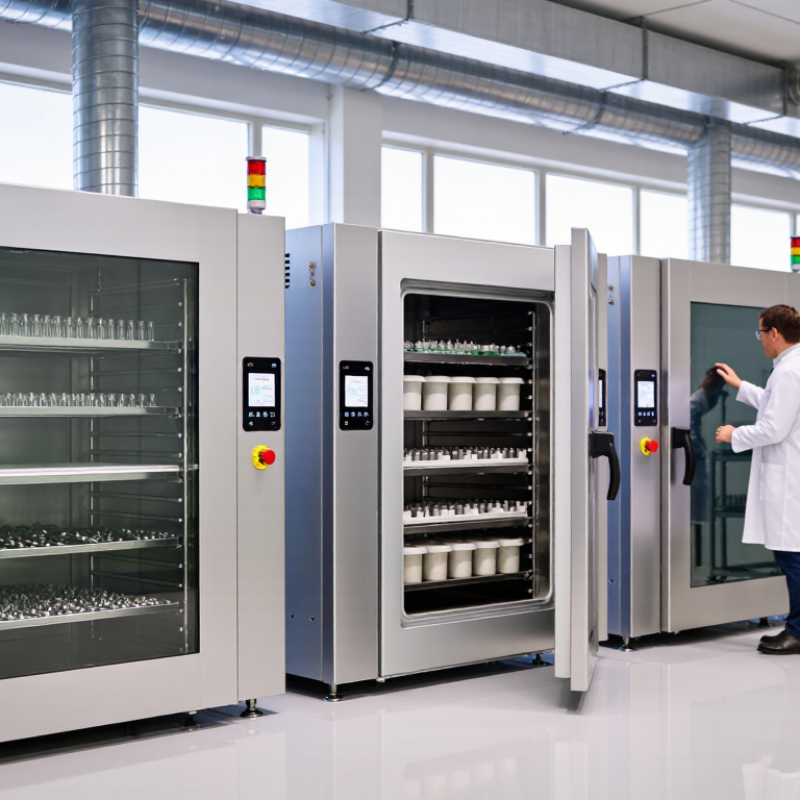
Laboratory drying ovens use convection to move heat around a chamber. Natural-convection models rely on warm air rising and cooler air falling. They suit light loads that need gentle heating, such as glassware or small samples. Forced-convection models use a fan to circulate air and often recover temperature faster after the door opens. The fan can also disturb powders or lightweight materials, so airflow is not always an advantage. Some ovens reach roughly 200–250°C, but the maximum rating varies by design. A 250°C setting is not a promise of equal temperature at every shelf.
Look beyond the number on the control panel. Ask for the stated temperature uniformity, stability, and recovery time, and check the conditions used for those measurements. Empty-chamber results may differ from a fully loaded oven. Not enough.
For a practical check, place a calibrated probe near the front, rear, and center shelves during a representative run. Keep trays spaced so air can circulate; tightly stacked glassware can create cool pockets. A rating alone is a blunt guide. It is easy to focus on the maximum temperature and overlook the load pattern, door use, or sensor placement. Those details can change the result.
Temperature uniformity is essential when drying products across several shelves. Ask manufacturers how they test a loaded oven, not only an empty chamber. A temperature map from probes at different shelf positions can reveal cold corners and hot spots. That matters. Small variations may affect moisture levels, drying time, and product consistency.
Airflow should reach the load evenly without disturbing lightweight materials. Check fan placement, vent design, and how the oven performs with trays fully loaded. Capacity figures can be misleading if they describe chamber volume rather than usable tray space. Energy use also deserves a practical measure: compare consumption per batch under similar load and temperature conditions. Better insulation and fewer unnecessary door openings can reduce heat loss. Still, one metric rarely tells the whole story; actual results depend on the product and loading pattern.
Tips: Request test data for your intended load, and ask how often temperature sensors need calibration. If possible, run a representative batch before purchase. A specification sheet is useful, but it may not reflect your daily workflow.
Indicative, manufacturer-independent uniformity bands for comparing general-purpose and precision oven specifications. Lower temperature deviation indicates more consistent heating.
How to compare: Confirm how uniformity is measured, including the test temperature, chamber loading, sensor locations, and stabilization time. Also compare usable capacity and airflow for your application. Energy use has no meaningful universal range; request kWh per cycle under a defined load and operating temperature.
A useful comparison of ten drying-oven manufacturers starts with oven type, rated temperature range, and intended industry—not headline capacity alone. Laboratory models commonly cover roughly 50–300°C, while production ovens may reach 500°C or higher; these figures are indicative, not interchangeable specifications. Check whether the rating describes the setpoint or the usable chamber temperature. A tray near the door can behave differently from one at the back.
Compare forced-convection, vacuum, cleanroom, and high-temperature designs against the actual material and batch size. Food and pharmaceutical users may prioritize repeatable drying and cleanable interiors; electronics producers often need controlled moisture removal without overheating components. The U.S. Department of Energy’s Improving Process Heating System Performance sourcebook identifies process heating as a major manufacturing energy use, making insulation, airflow, and cycle time practical buying criteria. Ask suppliers for loaded-chamber uniformity data, recovery time, and calibration details. ASTM E145 provides a recognized framework for laboratory oven performance, but it does not replace application testing. Specs can look tidy on paper. Real loads are messier. A small pilot run can expose uneven airflow or unexpectedly long drying times before a full installation.
For global buyers, IEC 61010-1 offers a practical safety benchmark for electrical equipment used in laboratory and control environments. Check whether the oven’s intended use and configuration fall within the standard’s scope. Ask for test documentation, not just a certificate. Look for evidence addressing electric shock, excessive surface temperatures, and abnormal operating conditions. Small details matter, such as protective earthing and how the unit responds if a temperature sensor fails.
ISO 9001 concerns the manufacturer’s quality management system; it does not certify that every oven performs equally well. Request records showing how production changes are controlled, components are traced, and nonconformities are corrected. Calibration procedures also deserve attention. A clear record should identify the instrument, date, and next calibration due date. Paperwork matters. So does evidence.
Compare the documents with the actual equipment specification, including voltage, usable chamber size, and over-temperature protection. Ask how final inspection results are retained and whether service staff can access relevant technical records. A polished compliance folder can still leave gaps. Buyers should verify that model numbers match across certificates, manuals, and quotations, then clarify any mismatch before purchase. One overlooked point is installation: a compliant oven may still need suitable ventilation, spacing, and local electrical checks.
Brand-neutral buyer benchmarks for comparing drying oven suppliers. These criteria describe evidence to request; they do not represent verified ratings or certifications of any specific manufacturer.
| No. | Evaluation Dimension | Practical Benchmark | Evidence to Request from the Manufacturer | Why It Matters |
|---|---|---|---|---|
| 1 | Electrical safety — IEC 61010-1 | Confirm that the oven’s electrical and control design has been assessed against the applicable edition of IEC 61010-1, which covers general safety requirements for electrical equipment used for measurement, control, and laboratory purposes. | Applicable conformity documentation and, where available, a safety test report identifying the evaluated model or product family. | Supports assessment of hazards such as electric shock, fire, and foreseeable equipment misuse. |
| 2 | Heating-equipment safety — IEC 61010-2-010 | For laboratory equipment that heats materials, ask whether the relevant particular requirements of IEC 61010-2-010 were considered in addition to the general requirements of IEC 61010-1. | Product-specific conformity information that identifies the standards and model covered. | This particular standard addresses safety considerations specific to laboratory equipment used for heating materials. |
| 3 | Quality management — ISO 9001 | Check for a current ISO 9001 certificate covering the manufacturing site and activities relevant to the oven being purchased. | Certificate number, issuing certification body, scope, covered site, and validity details; verify these with the certification body where appropriate. | A quality management system provides a structured approach to controlled processes, corrective actions, and continual improvement; it does not by itself certify a particular oven’s performance. |
| 4 | Operating temperature range | Compare the stated usable operating range with the process setpoints required by the buyer. There is no single temperature range that applies to all drying ovens. | Model datasheet stating the usable range, ambient conditions, permitted loading, and any operating limitations. | Helps determine whether the selected model is suitable for the intended drying process without relying on a headline maximum temperature alone. |
| 5 | Temperature accuracy and stability | Assess accuracy and stability as separate specifications, and check the stated test conditions and measurement location. | Technical specifications or test results defining the measurement method, setpoint, sensor location, and operating conditions. | Accuracy concerns how closely the indicated or controlled temperature matches a reference; stability concerns temperature variation over time. |
| 6 | Temperature uniformity | Request a uniformity specification or temperature-mapping results for the chamber, with the test conditions clearly stated. | Mapping report identifying chamber locations, setpoint, stabilization period, load condition, and measurement equipment. | Chamber temperature can vary by position; test conditions are needed to interpret a uniformity figure meaningfully. |
| 7 | Overtemperature protection | Confirm the presence and operating behavior of overtemperature protection, including whether its setpoint can be adjusted independently of the main temperature controller. | Operating manual, safety-system description, and test or validation procedure for the protective function. | A separate protective function can help limit overheating if the normal control system fails; suitability depends on the application and risk assessment. |
| 8 | Airflow, exhaust, and sample compatibility | Check the airflow design, ventilation requirements, and permitted sample types against the intended process. Do not assume a standard drying oven is suitable for flammable or explosive atmospheres. | Installation and operating instructions, ventilation requirements, and written confirmation of application limitations. | Air exchange and sample properties can affect drying performance and safety. Special hazards may require specifically designed equipment and controls. |
| 9 | Calibration and traceability | Ask whether temperature-measuring instruments can be calibrated and whether calibration results can be linked to recognized measurement standards. | Sample calibration certificate, calibration procedure, and details of the calibration provider; consider an ISO/IEC 17025-accredited laboratory where appropriate. | Documented calibration supports confidence in measurement results and helps organizations meet their own quality or regulatory requirements. |
| 10 | Documentation and lifecycle support | Evaluate the completeness of technical documentation and the availability of service, spare parts, and support in the buyer’s destination market. | Operating and maintenance manuals, parts information, warranty terms, service contacts, and stated support arrangements. | Clear documentation and accessible support help with installation, routine maintenance, troubleshooting, and continued operation. |
Buyer note: IEC conformity, ISO 9001 certification, and product performance are separate matters. Verify certificates and test evidence for the exact model, manufacturing site, and intended application before purchase. This table is a procurement checklist, not an independent ranking of manufacturers.
A 230/400 V label is only a starting point. Buyers should confirm phase, frequency, available circuit capacity, and the oven’s actual heater load before comparing quotes. A 400 V, three-phase model may suit a high-capacity site, while a 230 V supply may fit smaller installations; local configurations vary. Small details matter. Ask for the wiring diagram and written confirmation that the quoted configuration matches the destination site.
Eurostat reported an EU average electricity price near €0.18 per kWh for non-household users in the first half of 2024. As a rough comparison, a 6 kW oven running eight hours daily for 250 days would use 12,000 kWh, or about €2,160 at that rate. This assumes full-load operation. Actual consumption depends on heat-up time, insulation, door openings, and heater cycling. It is a planning estimate, not a bill forecast.
Service coverage affects downtime as well as cost. Request local commissioning options, response-time targets, spare-part lead times, and calibration support in writing. Compare fan, gasket, and control replacements over the expected service life, not just the purchase price. ISO 15686-5 provides a life-cycle costing framework; it does not supply oven-specific savings figures. Some suppliers may not provide reliable duty-cycle data, so leave room for uncertainty in the comparison.
Taking Custom Design to New Levels

Brin Glass Company | Minneapolis, MN
St. Germain’s Glass | Duluth, MN
Heartland Glass | Waite Park, MN

Fabricator
Inside Sales and Client Support Manager
Glass Handler – 1st Shift