Taking Custom Design to New Levels
PROUD TO BE PART OF THE BRIN FAMILY OF COMPANIES

OTHER BRIN LOCATIONS
Brin Glass Company | Minneapolis, MN
St. Germain’s Glass | Duluth, MN
Heartland Glass | Waite Park, MN

Choosing the best 180 Degree Concealed Hinge for 2026 starts with a practical question: what must the door clear? A full opening can help when wide cabinet doors sit beside walls, drawers, or neighboring units. But “180 degrees” does not guarantee the same movement in every installation. Hinge geometry, mounting plates, door thickness, and cabinet construction all matter.
As a clearly illustrative expert voice—not a verified quotation—cabinet-hardware specialist “Alex Morgan” puts it this way: “A wide opening only works well when the hinge, cabinet, and door are designed to move together.” Treat that as a useful principle, not a sourced industry quote. Check each manufacturer’s technical drawings before comparing models. Look closely at the stated opening angle, overlay or inset configuration, adjustment range, and required clearance. Small details matter. A handle can strike a wall. A thick door may need a different setup. Even a few millimeters can change the fit.
This guide will compare common 180-degree concealed hinge types, including clip-on and screw-fixed designs, and explain where each may suit a project. It will also consider soft-close options, load capacity, materials, and installation needs. The best choice is not always the most feature-rich one. Sometimes the catalog leaves out a detail you need. Measure the actual cabinet, test a sample when possible, and confirm compatibility before ordering.
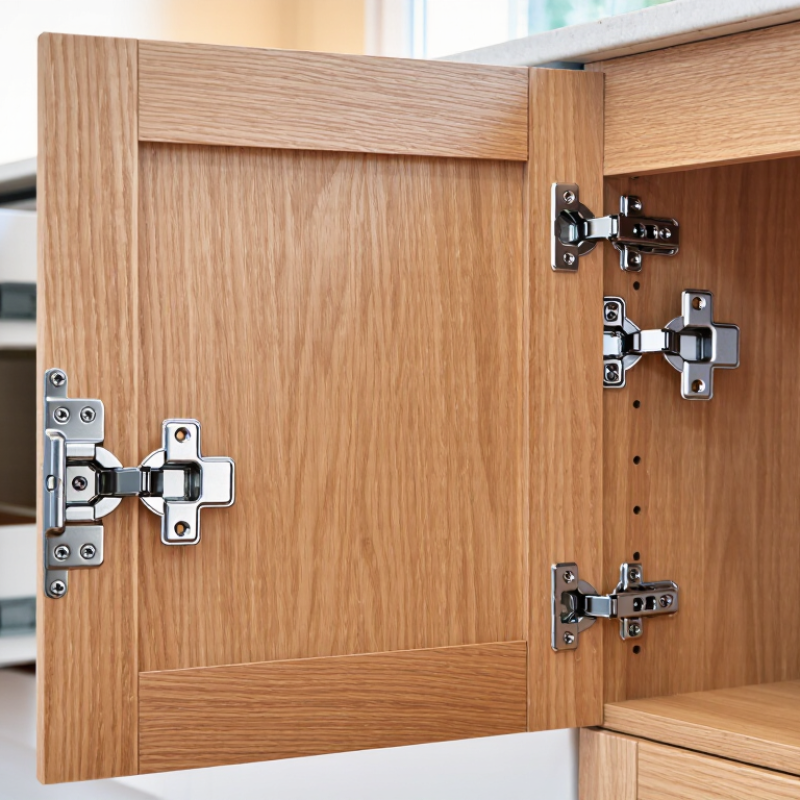
A 180° concealed hinge describes a hinge designed to let a cabinet door swing nearly flat against the cabinet side. The actual opening angle can vary with the cabinet, door thickness, and nearby walls or hardware. Check the hinge’s technical drawing, not just its name. Clearance matters.
Cup size is the diameter of the recess drilled into the door. A 35 mm cup is common, while compact doors may need a smaller cup. Diameter is only part of the fit: cup depth, edge distance, and door thickness also affect installation. Measure carefully. A few millimetres can change the result.
Mounting style describes how the door sits against the cabinet: full overlay covers the side, half overlay shares it with another door, and inset sits within the opening. The hinge arm and mounting plate help set that position. In practice, a product listing can make these options sound simpler than they are. Compare the cabinet dimensions with the hinge diagram before drilling, especially when a near-180° swing is essential.
Define concealed hinges by opening angle, cup size, and mounting style
How to read this: The bars show representative nominal opening angles; actual travel varies by hinge design and cabinet clearance. A 35 mm cup is common in full-size concealed hinges, while 26 mm cups are used in some compact designs. Full overlay, half overlay, and inset describe door position—not opening angle. Confirm cup dimensions, mounting style, and required clearance against the specific hinge and cabinet.
Best 180 Degree Concealed Hinge Types for 2026
Full-overlay hinges place the door over nearly all the cabinet side, creating a clean, continuous front. Half-overlay hinges share a center partition between two doors, leaving part of the cabinet edge visible. Inset hinges sit within the opening, so accurate door sizing and alignment matter more. For any 180-degree opening, check the hinge maker’s clearance and mounting specifications; the opening angle alone does not guarantee the door clears nearby walls or handles.
A 35 mm cup bore is common, but matching the hole diameter is only part of the fit. Cup depth, setback, door thickness, and mounting-plate position also affect operation. Houzz’s 2024 U.S. Kitchen Trends Study reports that 76% of renovating homeowners upgraded cabinets, making hinge compatibility a practical detail in many remodels. ANSI/BHMA A156.9 provides performance requirements for cabinet hardware; use its scope alongside product specifications rather than treating a cup size as a durability rating. One caveat: cabinet construction can make a theoretically suitable hinge awkward in practice.
Tips: Measure the overlay or inset before drilling. Test one door first. Check full swing against adjacent walls, pulls, and drawers. A little measurement error shows.
| Comparison Point | Full-Overlay | Half-Overlay | Inset |
|---|---|---|---|
| Door position | The door covers most of the cabinet side or partition when closed. | Two doors share a cabinet partition; each covers part of the partition. | The door sits inside the cabinet opening, generally flush with the front edges. |
| Typical use | Cabinet ends or openings where a door should cover the cabinet side. | Paired doors mounted on opposite sides of a shared partition. | Cabinetry designed to show the face frame or cabinet carcass around the door. |
| Hinge geometry | Typically uses a relatively straight hinge arm; the required overlay depends on the door, mounting plate, and cabinet layout. | Typically uses a cranked arm to create partial overlay; the required offset depends on partition and door dimensions. | Typically uses a more deeply cranked arm to position the door inside the opening. |
| Typical closed-door relationship | Door front sits over the cabinet side. Overlay is set by the hinge and mounting plate combination. | Each door commonly covers roughly half of a shared partition, allowing for the specified gap. | Door edges remain within the opening, with clearance needed around the door for movement. |
| 35 mm cup bore | A 35 mm cup diameter is common. Cup depth and edge setback must match the selected hinge instructions. | A 35 mm cup diameter is common. Cup position must be checked against the shared partition layout. | A 35 mm cup diameter is common. Cup position must leave enough door material and avoid clashes inside the cabinet. |
| Common cup-bore planning range | Many hinges use a cup depth around 11–13 mm; edge setback varies by hinge and door design. | Many hinges use a cup depth around 11–13 mm; confirm the required setback and minimum door thickness. | Many hinges use a cup depth around 11–13 mm; confirm the required setback and inset clearance. |
| 180-degree opening | Possible only with a hinge specifically designed and rated for a wide opening; nearby walls or cabinet sides may limit travel. | Possible with a suitable wide-angle hinge, but paired doors and the partition can restrict the opening. | Possible with a suitable wide-angle hinge, subject to opening width, door thickness, and cabinet clearance. |
| Adjustment considerations | Check overlay, side clearance, and door alignment after fitting. Adjustment range varies by hinge and plate. | Set both doors evenly and verify the gap over the shared partition. | Check reveal gaps on all sides and confirm that the door does not bind against the opening. |
| Best fit when | You want broad coverage of the cabinet side and a conventional overlay layout. | You need two doors to share one partition without either door covering its full width. | You want the door face to sit within the cabinet opening rather than over the cabinet front. |
| Before ordering | Verify the specified opening angle, door thickness and weight limits, cup diameter and depth, cup setback, mounting-plate height, required overlay or reveal, and available clearance. “180 degree” describes a hinge’s rated or advertised opening capability; the actual opening depends on the cabinet installation. | ||
Note: Dimensions and hinge geometry vary by design. The ranges shown are common planning references, not universal specifications; use the installation drawing for the exact hinge being fitted.
A 170°–180° concealed hinge can make a cabinet or access panel easier to reach, but its rated angle is only part of the story.
A 170° model may provide ample clearance when the door opens beyond nearby drawers or equipment. A true 180° opening can bring the door closer to parallel with the cabinet side, creating a wider approach.
That extra movement matters in tight service areas. Check the hinge drawing against the door thickness, frame, handle, and nearby wall. A handle that catches the wall can limit access long before the hinge reaches its rated angle.
Measure the real opening. Compare the clear space with the object you need to remove, not just the door’s swing.
For a heavy or frequently used door, check the hinge’s load rating and required number of hinges using its installation guidance. Mounting accuracy matters; small alignment errors can cause rubbing or uneven gaps.
Test it in place. A sample installation is useful, though it may not reveal every issue once shelves or adjacent doors are fitted.
The practical choice is the hinge that gives reliable access in your actual layout, not simply the highest angle printed in a specification.
When comparing 180-degree concealed hinges, check the rated load and test conditions, not just the opening angle. Soft-close models use a damper to slow the door near closure, reducing sharp impacts on the cabinet frame. Free-swing models have no damping mechanism, so they open and close with less resistance. That can suit doors needing quick, unrestricted movement. The actual opening clearance may vary with hinge geometry and cabinet construction.
A load rating should match the door’s weight and dimensions, with the number of hinges specified for that rating. A wide, heavy door places different stress on its hardware than a narrow one. Cycle-test results can help show how a hinge performs through repeated opening and closing, but test setup matters. Compare the stated cycle count alongside load, door size, and test method. A high number alone is not a guarantee of service life. I would be cautious about treating it as one.
Tips: Check whether the load rating applies per hinge or per set. Confirm that cycle tests used comparable conditions. During fitting, look for even gaps and listen for scraping; small alignment errors can affect movement and wear.
Best 180 Degree Concealed Hinge Types for 2026? Verify Durability and Hardware Requirements Against ANSI/BHMA A156.9
A 180-degree opening claim describes movement, not service life. For cabinet hinges, ANSI/BHMA A156.9-2020 provides performance requirements and test methods; check the applicable hinge category and grade rather than relying on an angle label. Angles can mislead. Ask for a laboratory report identifying the tested hinge, sample setup, operating-cycle results, applied loads, and any failures. Compare its recorded figures with the standard’s requirements for that specific classification. A report without test conditions is hard to evaluate.
Fit matters, too. Confirm door thickness, overlay or inset configuration, mounting-plate compatibility, and clearance at the full opening angle. A hinge that reaches 180 degrees in a test fixture may bind against a nearby wall or cabinet pull in a real installation. For a durable selection, keep the ANSI/BHMA A156.9 edition and grade beside the supplier’s test report, then match both to the project’s expected use. Do not treat a higher cycle count alone as proof of better performance; load, adjustment, and installation conditions matter. I would verify those details before specifying the hinge, even when the paperwork feels repetitive.
Taking Custom Design to New Levels

Brin Glass Company | Minneapolis, MN
St. Germain’s Glass | Duluth, MN
Heartland Glass | Waite Park, MN

Fabricator
Inside Sales and Client Support Manager
Glass Handler – 1st Shift